People Precision

  • Home
  • About
    • Testimonials
  • Services
  • Assessment Tools
    • Sample Reports
  • Blog
  • Contact

September 9, 2014 by Marty Reaume

Why Paying Unhappy Employees $25K to Quit is Crazy

Guest Post by: Bill J. Bonnstetter

How is one company determining whether unhappy employees want to stick around? Dangling cold, hard cash in their face.

Riot Games, Inc. is offering up to $25,000 for employees to up and leave the company, no questions asked, within 60 days of employment if they are unhappy in their jobs.

The Santa Monica, Calif.-based videogame maker believes simply throwing money at the problem and shooing unhappy employees out the door will solve their talent apocalypse.

cost of not hiring the right employee for the job“Rather than allow mismatches to fester, we want to resolve them quickly,” Riot Games explained in their announcement. “This is good for the company, and good for the professional.”

Riot Games isn’t alone in this farcical proposal.

Their offer comes on the heels of similar enticements by Internet retailers Zappos.com and Amazon.com, which pay employees $2,000 and $5,000, respectively, if they opt to quit.

Problem is, these pay-to-quit strategies aren’t solving anything.

If Riot Games is willing to pay a sum commensurate to someone’s annual salary just to get rid of them, how much would they be willing to pay someone to ensure they’re a proper fit from the onset?

Riot Games is almost guaranteed to see a revolving door of employees deciding a sudden $25,000 windfall is worthier than being locked into a game of chicken, where each player — employee or employer — is waiting to see who will act first.

There are better ways to ensure people aren’t just sticking around for a paycheck.

Regrettably, Riot Games is treating the symptom and not the cause, and interestingly, could have the right person in their doors but merely in the wrong position.

If only Riot Games took the time to determine a proper fit from the get go — hiring shouldn’t be a personality contest — or worked with employees to see where their talents could be put to better use.

Hiring right the first time through a benchmark approach, and using validated assessments, is an inexpensive way to achieve maximum performance.

As we say here at TTI: If the job could talk, it would explain precisely what was necessary to achieve superior performance. We could ask it to tell us about the:

  • Knowledge a person needs
  • Personal attributes required to drive success
  • Rewards for superior performance
  • Hard skills vital for the job
  • Behaviors necessary to perform at peak levels
  • Intrinsic motivators

Because if companies like Riot Games don’t have a plan in place to bring in the right people who are energized and dedicated from Day 1, then they are simply throwing money out the window.


ABOUT THE AUTHOR
Bill J. Bonnstetter is chairman of TTI Success Insights and founder and chairman of Target Training International. He is considered one of the pioneers in the assessment industry because of his significant contributions to the research and study of human behavior. @bbonnstetter


Filed Under: Employee Recruitment, Executive Leadership, Hiring Tagged With: employee incentives, employee turnover, hiring the right employee

August 19, 2014 by Marty Reaume

Hiring (not Firing) for Soft Skills

Guest Post by: Cindy Rosser

When you’re in the process of reviewing potential candidates, it’s easy to fall prey to common biases, especially when you rely on resumes and interviews.

According to a study by Michigan State University, employment interviews are only 14% accurate, and yet 90% of all hiring decisions are made from interviews.

how to select best job candidate

So how do you select the best candidate to serve your company and ensure tangible results that elevate your brand and mission as an organization?

Some of the most commonly overlooked factors in the hiring process are a candidate’s competencies, or soft skills. For many jobs, soft skills are as important as technical skills in producing superior performance. In fact, soft skills are often transferable to different jobs, whereas technical skills are usually more specific.

Let’s say a candidate you’re considering has been using your CRM system for most of her career. In the short term, you may be confident that she understands the functionality of the system. Perhaps even she’s developed mastery of the system. She can run a query, invoice a customer and import/export data. However, do you know if she has developed personal accountability, a measure of the capacity to be answerable for personal actions?

Does her problem solving ability require further development as she anticipates, analyzes, diagnoses and resolves problems? What about her flexibility? How agile will she be in adapting to change if the company were to switch CRM systems, and does she posses the initiative in learning and implementing new technologies that comes from having the well developed skill of continuous learning?

By identifying the soft skills that will make a person excel in a specific position within your company, you will help ensure proper job fit. Your employee will shine, and when she shines, that resonates throughout the organization, and your customers will see it too.

To read more about our selection process click here.


ABOUT THE AUTHOR
Cindy Rosser is a Solutions Consultant at TTI Success Insights, dedicated to serving the company’s network of independent coaches, consultants, speakers and trainers.

Filed Under: Employee Recruitment, Hiring, Human Resources Tagged With: hire right job candidate, hiring the right employee, recruiting high performers, select best job candidate

August 12, 2014 by Marty Reaume

Superior Interview Questions for Superior Employees

Guest Post by: Adam Wong

For those seeking to hire new talent, the internet is full of pages and pages of potential interview questions to ask candidates.

There are the lists of traditional questions:

what questions to ask in job interview

  • What interests you about this company and this job?
  • What did you like or dislike about your previous job?
  • What was your biggest accomplishment in this position?
  • Have you ever had difficulty working with a manager?
  • How do you evaluate success?

Then, there are the eccentric questions that promise to explore the candidate’s psyche, catching him or her off guard and away from canned responses:

  • What song best describes your work ethic?
  • What do you think about when you are alone in your car?
  • If we came to your house for dinner, what would you prepare for us?
  • How would people communicate in a perfect world?
  • If you could be anyone else, who would it be?

And yes, these are actual interview questions Fortune 500 companies asked their candidates over the last year (courtesy of Glassdoor).

Now imagine that prior to recruiting candidates, you were able to reveal the necessary Behaviors (DISC), Motivators and competencies that a job required. You would know that the type of person you’re looking for is, say, comfortable with analysis of data, as the job requires that details, data and facts are analyzed and challenged prior to making decisions, and that important decision-making data is maintained accurately for repeated examination.

You would also identify that a successful candidate for this position would value knowledge for knowledge’s sake, appreciating one’s continued education and intellectual growth. In addition, you would recognize distinct competencies that the job necessitates, such as the ability to write clearly, succinctly and understandably; the ability to identify and prioritize activities that lead to a goal; and the ability to imagine, envision and predict what has not yet been realized.

Knowing all of this information about the job itself, your ideal candidate easily comes into focus, and interview questions that correspond directly with the specific needs of the job will yield more valuable results. Referencing those necessary behaviors, motivators and competencies, your interview questions for this particular job might look like this:

• How do you organize details for use and recall? What system do you use?
• Would you consider yourself to be an expert in something? What is it? How did you go about gaining the knowledge?
• How do you know when something you’ve written has achieved its communication goal?
• Describe the most complex project you ever worked on. How did you establish action steps and milestones for that project? What was the most difficult part of that project for you?
• Give me an example of when you predicted something that would happen in your department, organization or industry. What caused you to make that prediction?

Once you experience a job benchmarking process, it’s easy to see why there’s not one ideal list of interview questions. Each job has its own demands, and if candidates aren’t “one size fits all,” then the interview questions can’t possibly be either.

To learn more about improving your recruiting process by implementing TTI’s patented job benchmarking system, contact your TTI-certified consultant, or call (800) 869-6908.


ABOUT THE AUTHOR
Adam Wong is Director of Network Development for TTI Success Insights, driving excellence through careful thought and attention to detail, consistently anticipating the needs of all customers. He serves as an integral member of the product development team, creating new products and improving existing tools to better support the company. @TTISI_Adam

Filed Under: Hiring, Human Resources, Job Interviewing, Talent acquisiton Tagged With: hire right job candidate, hiring best candidate, hiring the right employee, interview questions

August 5, 2014 by Marty Reaume

Multivariate Analysis Leads to Predictability

Guest Post by: Bill J. Bonnstetter

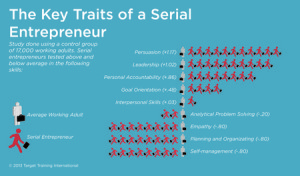
New research demonstrates the value of using multiple assessments to predict and identify entrepreneurs.

TTI’s statistician uses multivariate analysis, which involves observations and analysis of more than one statistical variable at a time. Using this approach, TTI analyzed its database of serial entrepreneurs showing the following results:
using assessments to identify entrepreneurs

  1. If we only used Behaviors (DISC) to identify serial entrepreneurs, we would be correct 60% of the time.
  2. If we only used Motivators, we could correctly identify serial entrepreneurs 59% of the time.
  3. If we used both Behaviors (DISC) and Motivators, our accuracy goes up to over 80%.
  4. However, if we add soft skills into the equation, our success rate of picking serial entrepreneurs goes up to 92%.

Serial entrepreneurs have five unique soft skills in common: leadership, personal effectiveness, goal orientation, persuasion, and interpersonal skills.

This research proves that TTI’s approach to using multiple assessments to benchmark a job is much more effective than using just one assessment for selection like some other assessment companies advocate.

We will be conducting multivariate analyses on other unique groups, such as sales people, leaders and entrepreneurial-minded engineers. Stay tuned for more research data.


ABOUT THE AUTHOR
Bill J. Bonnstetter is chairman of TTI Success Insights and founder and chairman of Target Training International. He is considered one of the pioneers in the assessment industry because of his significant contributions to the research and study of human behavior. @bbonnstetter
Filed Under: Employee Development, Executive Leadership Tagged With: hiring the right employee, hiring tools, serial entrepreneurs, talent assessment tools

July 29, 2014 by Marty Reaume

What makes some businesses soar and others fail?

Guest Post by: By Dr. Ron Bonnstetter

What makes some businesses soar and others fail? The usual answer is economic conditions, poor market analysis or under capitalized.

building strong work teamsBut a strong business must start with a strong team. A team inspired by a common goal and a crystal clear purpose.

For several years now, Simon Sinek, consultant and author of Start with Why, has been explaining that our best employees do not work for a result but for a purpose. Their focus is not on what the business does, but on why they are there and their role in promoting a belief, a vision. He believes that much of our marketing and hiring practices need to be inverted.

For example, most employees can tell you “what” they do and even how they do it. But can they tell you “Why” they do their job? What is at the core of your business? What are the core values and beliefs that drive your organization? If you are having difficulty seeing the application and implication in business, just look at educational reform for perspective.

Since the implementation of No Child Left behind, our national focus has been on the what (higher test scores) and the how (more rigor), and we have forgotten the richness that only comes when we promote the why of education. The why component includes beliefs in the love of learning, the sharing of a teachers’ passion for a subject and the joy of accomplishments driven by mutual and shared visions.

Now back to the business world. The best businesses understand the power of shared beliefs. When a team has a shared set of purposes, they go the extra mile, not for overtime, but for a cause and mission that is bigger than any one individual. This is devotion verses salary.

The neuroscience behind this concept is also solid. We know that our newest brain, the neocortex, offers humans rational and analytical thought. It also allows us to verbally communicate through language development. This brain region serves us well as we handle the many daily encounters with the What’s and the Hows’ of life.

But recent neuromarketing research suggests that up to 95 percent of our decisions are made at the subconscious level. In other words, not the neocortex, but our much older and deeper brain region called the limbic system. This complex set of brain structures controls emotions, behavior, motivation and long term memory. Oh, it also has no capacity to support language.

As a result, many of our behaviors, are driven by this paleomammalian brain. These driving beliefs are hard to verbalize, but they are driving the bus and helping us decide what is important.

In summary, if you promote a product, whether education or your business, by focusing on the what and how features, you will fail to capture the heart of your employees or your customers. Remember that the why behind our actions is the most powerful influence you have at your disposal. The next time someone ask you “What you do?” Start by passionately explaining “why” you care enough to do what you do.

I wonder why I wrote this?

To read other posts about this topic, click here.

Filed Under: Employee Development, Executive Leadership, Team Performance Tagged With: building strong teams, employee incentives, hiring the right employee, teamwork

Request your free assessment!

Connect with People Precision!

  • Email

Recent Posts

  • Are your Talent Acquisition Initiatives Penny Wise and Pound Foolish?
  • Why Paying Unhappy Employees $25K to Quit is Crazy
  • Achieving your Strategic Plans with Superior Talent
  • How to Hire and Retain Top Talent
  • Hiring (not Firing) for Soft Skills

Testimonials

We were a much more thoughtful and strategic hiring team with their guidance, coaching and the tools they worked with us to implement.  

James Ramsey
Founder, Board Member at Vlocity Inc.

Accreditations

Connect with People Precision!

  • Email

PEOPLEPRECISION

Phone: 416.616.6353

Recent Posts

  • Are your Talent Acquisition Initiatives Penny Wise and Pound Foolish?
  • Why Paying Unhappy Employees $25K to Quit is Crazy
  • Achieving your Strategic Plans with Superior Talent
  • How to Hire and Retain Top Talent
  • Hiring (not Firing) for Soft Skills
  • Superior Interview Questions for Superior Employees

Recent Comments

    Tags

    building strong teams costs of employee turnover employee development plans employee incentives employee turnover hire right job candidate hiring best candidate hiring for longterm hiring the right employee hiring tools hiring top talent human resources interview questions recruiting high performers recruiting top talent recruitment methods retaining high performers retaining top talent select best job candidate serial entrepreneurs strategic planning succession planning talent assessment tools teamwork

    © 2026 People Precision | Site Design By Pepper It Marketing | Privacy Policy
    Serving both Canada and the United States